
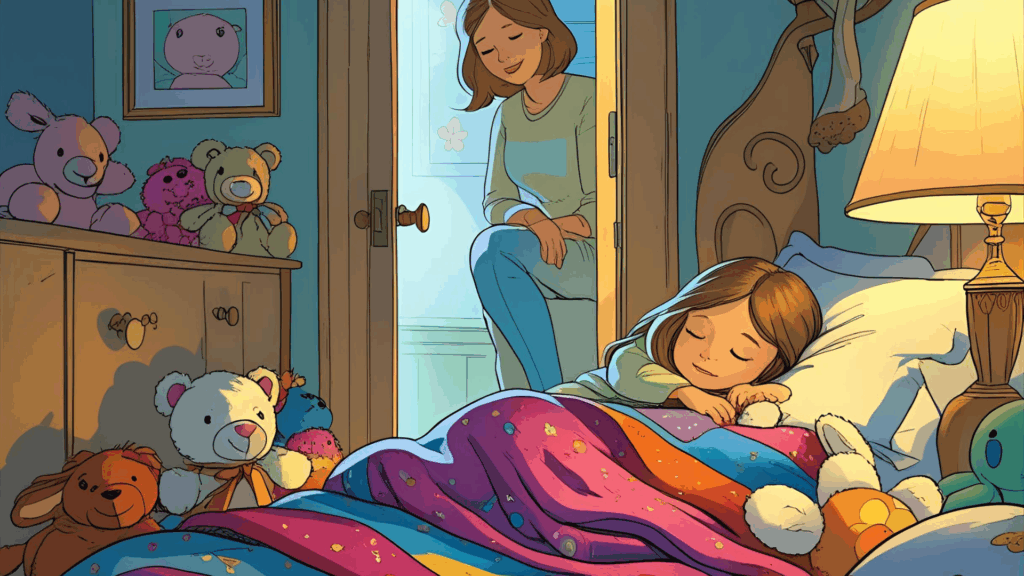
It wasn’t the first time, but there was something different about how she said it. “Mom, I think I want to try sleeping by myself tonight.”
She’s only five. And while her older brother started sleeping alone at six, I didn’t expect her to ask so soon.
Part of me wanted to say no. I imagined the what-ifs—what if she wakes up scared? What if she feels alone and I’m not there fast enough? What if she thinks I’m pushing her away?
But the other part of me—the part that’s learning to trust her growth—whispered, “Say yes.”
So we did the bedtime routine as usual. Story, cuddles, lights off. I stayed for a few extra minutes, just until her breathing slowed and the room felt still.
And then I went back to our room.
It wasn’t a perfect night. She woke up once at 2 AM, called out, and I walked over to her room. No big tears. Just a quiet “I had a weird dream,” and a tight hug. She went back to sleep.
In the morning, she was proud. She ran to the kitchen, her bed hair sticking up in every direction, and said, “I did it, Mom!”
That moment erased every ounce of guilt I had the night before.
Guilt often creeps in when we associate independence with emotional distance. Parents worry that by letting their child sleep alone, they’re being less nurturing. That they’re choosing convenience over connection.
We fear the transition might be too soon, or that our child will interpret it as abandonment. In some cultures, co-sleeping is the norm well into childhood. So when we make a different choice, even if it’s developmentally appropriate, we second-guess ourselves.
The guilt isn’t always about the child. Sometimes it’s about us—missing those quiet nighttime snuggles or feeling like we’re rushing through milestones.
But here’s the truth: letting your child sleep alone doesn’t mean letting them go.
Letting your child sleep alone isn’t a sign of disconnection—it’s a step toward helping them build confidence, security, and self-regulation.
Here’s why it matters:
It normalizes boundaries. Healthy boundaries around sleep teach children about privacy, respect, and autonomy—important lessons for future emotional development.
You don’t need to rush the process or push your child too fast. Here’s how you can support them (and yourself) in the transition:
Letting your child sleep alone isn’t something to feel guilty about. It’s something to feel proud of—because it means you’re giving them room to grow, while still holding space for their emotions.
As a parenting coach and a fellow mom, I’ve learned that transitions are always two things: a little bit sad, and a lot empowering. We grieve the loss of the old routine, and then we cheer for what’s next.
Unguilty parenting is about knowing that choosing your child’s growth doesn’t mean losing connection. You can say, “Sleep well, I’m just in the next room,” and mean it with your whole heart.
Because you’re not leaving them. You’re leading them.
If you find yourself struggling with these feelings, seeking professional support can be beneficial. At Bricks and Blocks Coaching, we specialize in helping individuals find the right strategies, we offer tailored support to help parents navigate their unique challenges and find a path that works for them.
Reach out to us to learn more about how we can assist you in your parenting journey.