
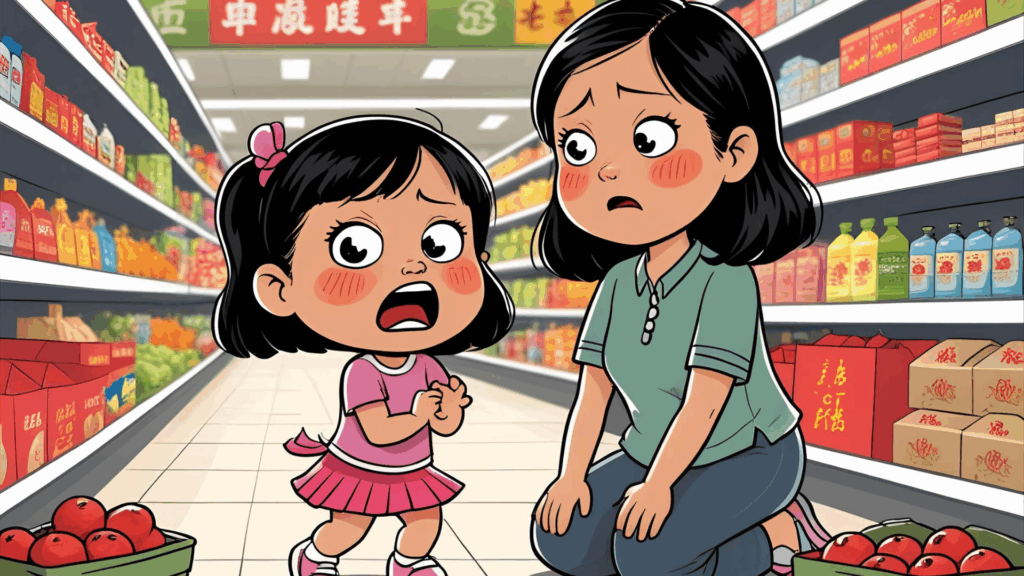
The supermarket floor was cold. And public.
My 5-year-old daughter was lying flat on her back between the snack aisle and the checkout counter, screaming because I wouldn’t let her have another pack of gummies. I could feel the judgmental stares burning through my back. A couple passed by, whispering something I couldn’t hear—but my mind filled in the blanks: “Why can’t she control her child?”
My chest tightened. My cheeks flushed. I crouched beside her, trying to stay calm, and whispered, “I know you really want the gummies, but we already chose a snack for today.”
That only made things worse.
She kicked her feet, screamed louder, and knocked over a small basket of mints next to her. I could feel the eyes on us—some from pity, some from annoyance. One store clerk even started walking toward us.
For a moment, I panicked. Should I give in just to make it stop? Should I pick her up and carry her out?
But then I took a breath and reminded myself: She’s not giving me a hard time. She’s having a hard time.
I gently moved the basket out of her way and sat down on the floor next to her—not towering over her, not dragging her—just quietly waiting. I spoke softly:
“You’re upset. You really wanted that snack. It’s okay to be mad.”
“I’m right here. We’ll wait together.”
A few minutes passed. She kept sobbing, but the yelling died down. Her body relaxed. Eventually, she rolled over, crawled into my lap, and whispered, “I’m tired.”
I held her close. “I know, sweetheart. That was a lot. Let’s go home.”
We walked slowly to the car. No gummies. No yelling. Just quiet, tired breathing.
At home, I gave her a warm bath, and she perked up a bit. While she played with her bath toys, I reflected on what had just happened. I had stayed calm, held the boundary, and didn’t let guilt run the show. Was it perfect? No. But was it connected? Yes.
That night, while she slept, I finally let myself cry a little—not out of shame, but release. Parenting is hard. Staying present during a tantrum is even harder. But that moment reminded me that holding space is more powerful than control, and sometimes, that’s exactly what our children need.
It’s a common question that haunts many parents—especially after public outbursts:
We feel guilt when our child has a meltdown because we internalize the behavior as a reflection of our parenting. In a world obsessed with control, calm, and curated social media parenting moments, tantrums feel like failures.
But here’s the truth: Tantrums are developmentally normal. Guilt doesn’t have to be.
Let’s break this down. Understanding both tantrums and the guilt that follows is essential for our growth as parents.
Tantrums are actually signs of emotional growth. Young kids don’t yet know how to say, “I’m overwhelmed,” “I’m tired,” or “I’m frustrated.” So they scream, cry, and flop on the floor.
Their nervous systems are still learning how to regulate. That meltdown? It’s communication. Not manipulation.
Guilt often stems from a place of love and care. We want to do right by our children. But guilt turns toxic when it leads to shame or makes us question our every move as parents.
When we give in to guilt, we may shift our boundaries, become overly permissive, or apologize for enforcing limits. Over time, this chips away at healthy consistency—something children need for emotional safety.
Can parenting guilt affect how I see myself?
Absolutely. When we constantly feel like we’re “failing,” we stop trusting our instincts. We lose confidence and stop celebrating the small wins that matter.
Here’s how to approach tantrums with calm, connection, and unguilty parenting in mind:
Before reacting, take one deep breath. Center yourself. Your child’s emotions are not your emergency. They’re cues for support, not control.
Use short, clear language:
“You’re sad because we had to leave the park.”
“You didn’t like that I said no to more cookies.”
Validation doesn’t mean agreement—it means acknowledgment.
Even when your child is upset, you can still say:
“It’s okay to be upset. But it’s not okay to hit.”
“We’re not getting another toy today. I know that’s hard.”
Boundaries with empathy build both trust and emotional security.
In public tantrums, resist the urge to “perform” parenting. Focus on your child, not the onlookers. Your calm presence is far more important than appearing “in control.”
When the storm passes, reconnect with your child. A gentle cuddle, a book, or a moment of play tells them:
“You are safe, loved, and accepted—even when you’re at your worst.”
Remind yourself: My child had a hard time. I showed up.
Progress isn’t perfection—it’s presence.
The truth is, tantrums aren’t just hard for kids—they’re hard for us, too. But when we meet those messy moments with compassion instead of shame, we build real connection.
Let’s normalize tantrums. Let’s normalize not always having the perfect response. Let’s normalize being a human parent raising a human child.
Guilt will knock at the door, but you don’t have to invite it in. You can choose to show up, hold space, and parent with strength and softness.
That’s what unguilty parenting looks like.
If you find yourself struggling with these feelings, seeking professional support can be beneficial. At Bricks and Blocks Coaching, we specialize in helping individuals find the right strategies, we offer tailored support to help parents navigate their unique challenges and find a path that works for them.
Reach out to us to learn more about how we can assist you in your parenting journey.