
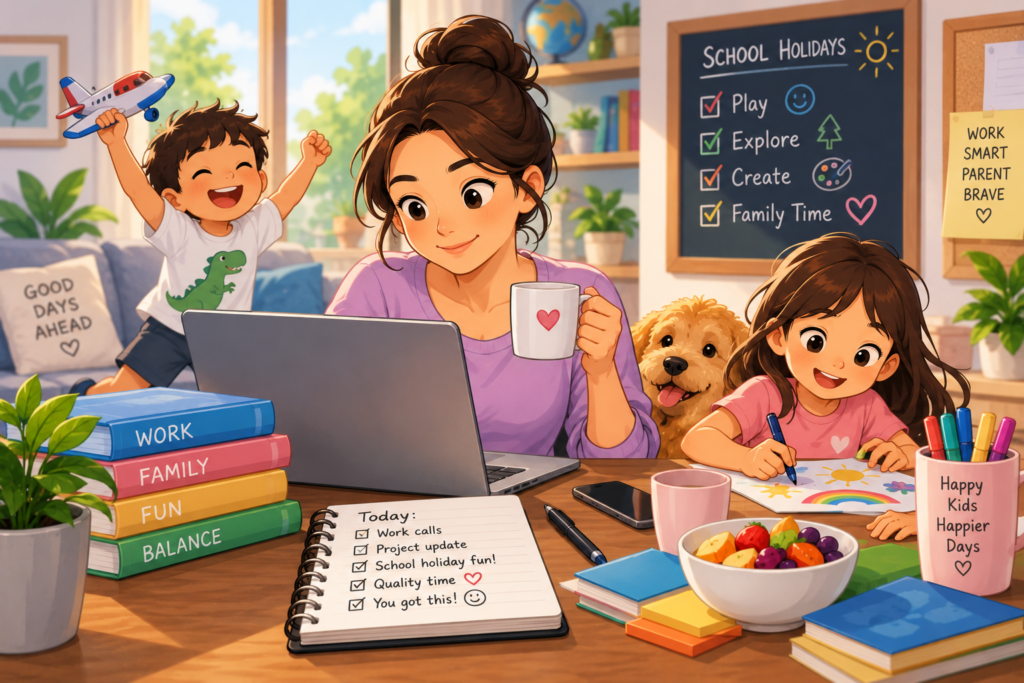
Deepa opened her calendar on the last Friday of term and did the sum she had been avoiding all week. Nine weekdays of school holiday. Four days of leave she could actually take without derailing her project. Her mother available for two of them, maybe three if the physiotherapy appointment moved. A holiday camp with places left, but only in the mornings, and on the other side of the island.
She sat looking at the gap for a while, and then closed the laptop, because there was no arrangement of those numbers that produced a covered week.
If you’ve ever had to navigate school holidays when you have to work, you already know how quickly the childcare arrangements start to get complicated. School stops. Work does not. And the space in between gets filled by one parent doing arithmetic at eleven at night.
The September break runs from the 5th to the 13th this year, which is short enough to feel manageable and long enough to break every routine in the house.
Term IV ends on the twentieth of November, and school does not resume until January, which is roughly six weeks of unstructured time landing in the same stretch as year-end deadlines, performance reviews and whatever your organisation calls its December crunch.
Most families solve this the same way, by stacking partial solutions. Some leave, some grandparent days, a camp or two, a neighbour swap, and a few days where you simply work with the children in the house and hope for the best. That is what makes school holidays so exhausting when you have to work. You rarely find one solution that covers the whole break.
The real problem is that assembling them is itself a job, and it almost always lands on the same person, alongside their actual one. That is invisible work in its clearest form: not the childcare, but the constant recalculating of who is where and what happens if one piece falls through.
There is a second cost that nobody puts on the spreadsheet. Holidays quietly dismantle the routines that make ordinary weeks possible. Bedtimes slide by an hour, then two. Meals drift. The sleeping arrangements you spent months settling come apart in nine days and take three weeks to rebuild. You are not imagining that the holidays feel harder than term time. Structurally, they are.
Here is what tends to catch people out. You are not failing at the holidays because you did not plan well enough. You planned exactly as well as the situation allowed. What the week actually looks like is something more like this:
The behaviour piece is worth naming honestly. Children who have lost their routine and their structure often become harder to manage. A child who is difficult in week two of the holidays is not proof of anything about your parenting. It’s just that children often need predictable boundaries and rhythms to regulate themselves, and the holidays are anything but that.
Most working parents treat flexibility as a favour they’ve already used up, which is usually not accurate. Among private companies here, 72.5% offered at least one form of scheduled flexible work arrangement in 2024, according to Ministry of Manpower survey data, up from 68% the year before.
Since 2024, the Tripartite Guidelines on Flexible Work Arrangement Requests have also set out a formal process for asking, and for how an employer should consider the request. Whatever your manager's instinct is, there is a route, and it’s not a personal favour.
The honest counterweight sits in the same data. Only 36.1% of companies voluntarily provided paid family care leave in 2024, and 34% paid child sick leave. So the flexibility that exists is mostly about when and where you work, not about being released from working.
That distinction matters for how you ask. A request to shift your hours, compress a week, or work a few days from home during a specific school break is a much smaller ask than time off, and it is the ask the system is actually set up to say yes to.
If working from home is part of your plan, treat it as a real arrangement rather than a fallback. Being physically present while unavailable is the version that makes everyone miserable, because the children can see you and cannot have you. This matters particularly during school holidays when you have to work, because being technically at home can create the expectation that you are also available.
These options won’t make the holidays magically easier. But they will take some of the pressure off your week.
A Final Thought on Surviving School Holidays When You Have To Work
Deepa's holiday week was not a triumph. Two days ran on cartoons and cereal, and she took one call from the bathroom with the door shut.
What changed was that she stopped treating the gap in the calendar as a personal planning failure and started treating it as a structural problem that she was covering as well as anyone could. She asked to shift her hours for the week, which she had assumed would be a problem and turned out not to be. The six-week stretch from late November is still coming, and it will still be hard. The question worth asking now is not how to cover it perfectly, but which pieces you are going to stop trying to hold on your own.
How do working parents in Singapore usually cover the school holidays?
Most families assemble a patchwork of annual leave, grandparents or helpers, holiday camps, and days where a parent works with the children at home. There is no standard solution, which is part of why the planning feels so heavy each time.
When are the 2026 school holidays?
The September holiday runs from 5 to 13 September, and the year-end holiday runs from 21 November to 31 December, according to the Ministry of Education's 2026 school calendar.
Can I ask my employer for flexible work during the school holidays?
Yes, and there is a formal route for it. The Tripartite Guidelines on Flexible Work Arrangement Requests set out how employees can request an arrangement and how employers should consider it. A time-bounded request tied to a specific school break is usually easier to grant than open-ended flexibility.
How much screen time is too much during the holidays?
There is no single answer, and holiday weeks are not the moment to hold a term-time standard. It helps more to decide in advance which limits you are relaxing, and to name that decision out loud, than to drift past your own rules and then feel bad about it.
Why does my child behave worse during the holidays?
Unstructured time removes the routine and the stimulation that school provides, and boredom often surfaces as arguing or emotional outbursts. It usually reflects a missing structure rather than a discipline problem, and it eases when the day has some visible shape to it.
Sources