
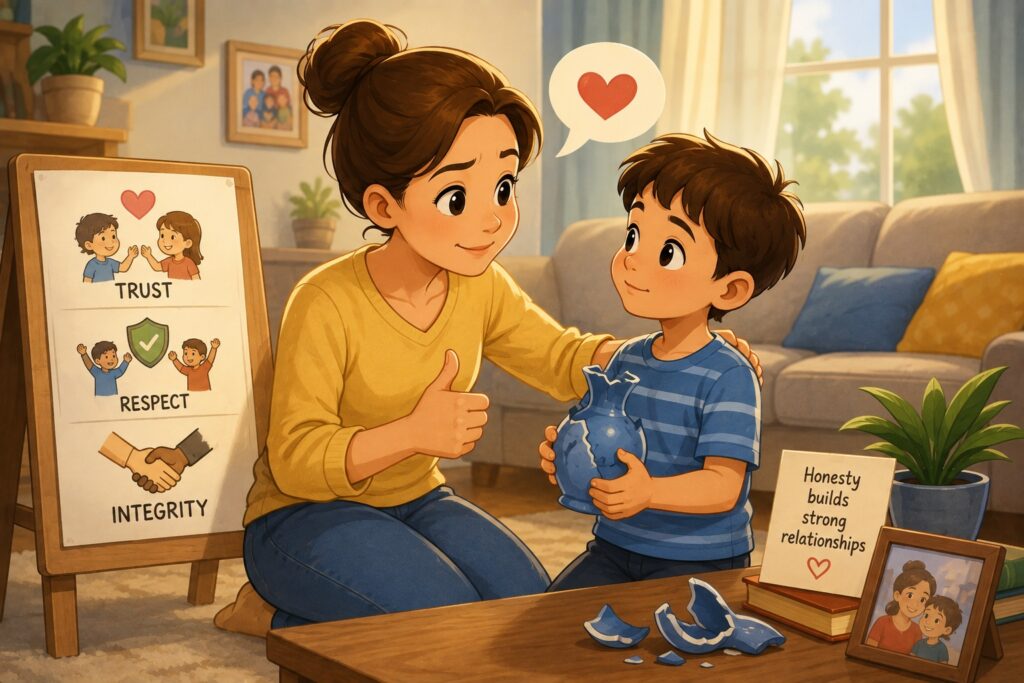
Honesty is the quality of being truthful, transparent, and sincere in one’s words and actions. It involves the absence of deceit, dishonesty, or misrepresentation. For parents looking to encourage honesty in children, teaching this value from an early age is essential. Honesty builds trust, fosters strong relationships, and helps children develop a strong sense of personal integrity.
In both personal and professional contexts, honesty serves as the foundation for credibility and reliability. It encourages open communication, supports ethical behaviour, and helps to create a harmonious environment where people feel valued and respected.
Teaching children the value of honesty is important, but learning to be truthful is a process. As children grow, they encounter situations where telling the truth may feel difficult, uncomfortable, or even tempting to avoid. Understanding why kids lie can help parents respond thoughtfully and find effective ways to encourage honesty.
Lying is a normal part of childhood development and does not necessarily mean that a child is dishonest by nature. Children begin to develop the ability to lie during the preschool years, as they become better at understanding that other people may have thoughts, beliefs, and knowledge that differ from their own.
The reasons behind a lie can also vary. Children may lie to hide something they have done, avoid consequences, protect their interests, or achieve a particular social goal. As they grow older, they also become better at making their stories more convincing.
This is why it helps to look at what is behind the behaviour rather than treating every lie in the same way. Understanding why kids lie can help parents respond appropriately and create an environment where children feel safe telling the truth.
When honesty is encouraged at home, your child will naturally show the following traits:
Stories can help children understand moral values, but research suggests that stories about honesty may be more effective when they show and praise truthful behaviour rather than focus on the consequences of lying.
In a study of children aged 3 to 7, researchers found that children who heard a story about George Washington being praised for admitting that he had cut down his father’s cherry tree were three times more likely to tell the truth about peeking at a toy than children who heard other stories.
In contrast, The Boy Who Cried Wolf and Pinocchio, which emphasize the negative consequences of lying, were no more effective than a story unrelated to honesty.
The findings suggest that when using stories to teach honesty, parents may want to focus on what children gain from telling the truth and show characters being honest, rather than relying only on warnings about dishonesty. The researchers also noted that more research is needed to determine whether these effects influence children’s behaviour over the long term. Read more about this experiment here.
Here are some effective strategies to foster honesty in children:
Demonstrate honesty in your own words, actions, and interactions. Children learn what honesty looks like by observing the adults around them.
Create a safe environment where children feel comfortable expressing their thoughts and feelings without fear of punishment or judgment.
Praise children when they tell the truth, especially when being honest is difficult, to show them that honesty is valued.
Help children understand how dishonesty can erode trust, damage relationships, and harm others.
Use everyday situations, stories, and role-playing to help children explore different choices and understand the value of telling the truth.
If children fear severe punishment, they may be more likely to lie to avoid getting into trouble. Focus on teaching rather than shaming.
Help children understand that being truthful does not mean being unnecessarily rude or hurtful. Teach them to communicate honestly and kindly.
Sometimes children lie because they are embarrassed, scared, or worried about disappointing you. Addressing these emotions can make honesty feel safer.
When a child is dishonest, help them correct the situation, take responsibility, and rebuild trust rather than simply focusing on the lie.
Stories provide a natural way to talk about truthfulness, trust, and the consequences of dishonesty without making the conversation feel like a lecture.
Pay special attention when children admit mistakes or tell the truth when they could easily have hidden it. Reinforce the message that telling the truth takes courage.
A memorable bank advertisement beautifully captures the essence of honesty.
In the ad, a father and his young son are heading to a theatre. As the father buys the tickets, he notices a sign that reads, “Free tickets for children under five.”
At the entrance, the doorman informs the father, “You didn’t need to buy a ticket for your son. I wouldn’t have known he was six.”
The father simply replies, “He knows.”
Honesty is a fundamental value that shapes character and builds trust. By cultivating honesty in ourselves and our children, we lay the groundwork for strong, authentic relationships and ethical behaviour. Teaching and practicing honesty not only enriches personal integrity but also fosters a more transparent and respectful society.
At Bricks and Blocks Coaching, we are dedicated to helping families strengthen their connections and foster essential values like honesty. If you need support or guidance in nurturing these qualities in your children, don’t hesitate to reach out.
Reach out to us today and let us assist you in building a foundation of trust and integrity for your family.
You can also listen to our podcast on our YT channel - Everyday Parenting