
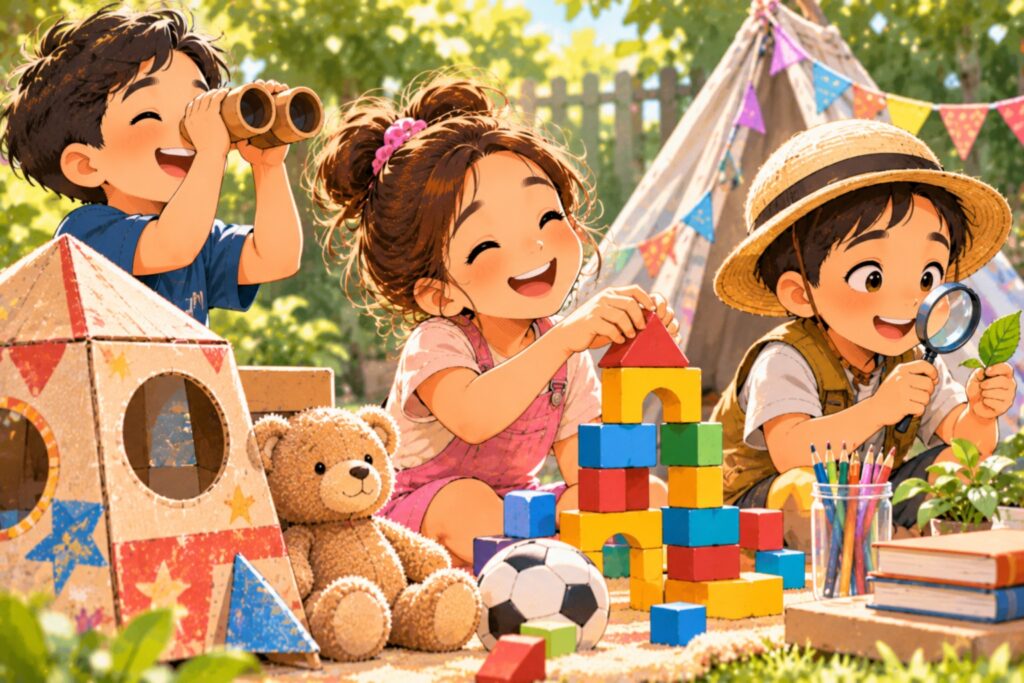
Play is one of the ways children learn about the world around them. Building with blocks, pretending to run a shop, playing with other children, or exploring outdoors can help them develop problem-solving skills, coordination, communication, and emotional understanding.
But play does more than teach individual skills. It gives children opportunities to make decisions, express themselves, build relationships and discover their interests. Understanding the different ways children play can help parents support their development without turning every activity into a lesson.
Play is much more than a way for children to have fun or pass the time. It is how they explore their surroundings, express emotions, build relationships, test their abilities, and make sense of the world around them.
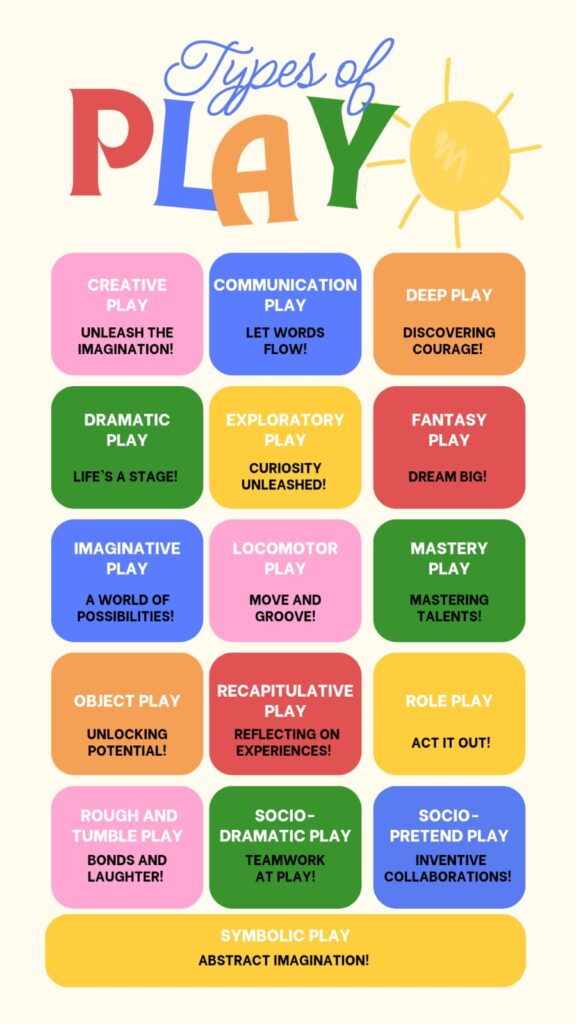
Playwork specialist Bob Hughes identified 16 types of play in his A Playworker's Taxonomy of Play Types. This framework helps parents and educators recognise the different ways children naturally engage with the world.
Understanding these types of play can help parents appreciate that learning does not always look like reading, writing, or completing structured activities. Sometimes, it looks like running around the garden, pretending to be a superhero, building a tower, or simply playing with friends.
Let's explore the 16 types of play and what they can look like in everyday childhood.
Creative play happens when children experiment with materials, ideas, and different ways of making things. Whether they are painting, drawing, building with recycled materials, or creating something from scratch, children have opportunities to express themselves and explore their creativity without worrying about achieving a perfect result.
Communication play involves expressing ideas through words, gestures, facial expressions, sounds, and body language. Activities such as telling jokes, making up rhymes, playing charades, or inventing silly words allow children to explore different ways of communicating and connecting with others.
Deep play involves experiences that children perceive as risky, challenging, or uncertain. Climbing to a challenging height, balancing on a narrow surface, or attempting something unfamiliar can give children opportunities to confront their fears, test their courage, and discover their abilities within appropriate safety boundaries.
Dramatic play happens when children recreate situations, events, or stories they have witnessed or experienced. They might act out scenes from their favourite television programmes, imitate characters, or recreate exciting events, allowing them to explore experiences through storytelling and action.
Exploratory play allows children to discover the properties of objects and materials through their senses. Playing with sand, water, mud, playdough, or natural objects gives children opportunities to investigate textures, shapes, sounds, and how different things behave.
Fantasy play allows children to create imaginary worlds where the usual rules of reality do not apply. They might pretend to have magical powers, become dragons, travel through space, or explore enchanted kingdoms. These experiences give children the freedom to imagine possibilities beyond everyday life.
Imaginative play happens when children explore possibilities beyond the ordinary rules of the physical world. They might pretend to have wings, walk on the moon, or move through an imaginary landscape. This form of play encourages children to experiment with ideas that go beyond their immediate surroundings.
Locomotor play involves movement for the enjoyment of movement itself. Running, jumping, climbing, spinning, swinging, and chasing are common examples. Through these activities, children explore what their bodies can do while experiencing the excitement and freedom of physical movement.
Mastery play happens when children explore their ability to control or shape their physical surroundings. Building forts, digging holes, constructing pathways, or repeatedly adjusting a structure allows them to experiment with how they can influence and organise their environment.
Object play involves exploring and manipulating objects to discover their properties and possibilities. Children might stack blocks, roll balls, spin wheels, or experiment with household items. These simple activities allow them to investigate how objects move, fit together, and respond to different actions.
Recapitulative play involves exploring elements of human history, ancestry, traditions, and earlier ways of living. Children might build pretend shelters, recreate historical activities, or engage with stories about how people lived in the past. This form of play allows them to imaginatively connect with human experiences across generations.
Role play happens when children take on different identities or responsibilities. Pretending to be a doctor, teacher, shopkeeper, firefighter, or parent allows them to explore familiar roles and experiment with different ways of behaving and interacting.
Rough-and-tumble play involves playful physical interactions such as wrestling, chasing, rolling, and tumbling. Unlike aggressive fighting, this type of play is generally characterised by mutual enjoyment and willingness to participate. It gives children opportunities to explore physical interaction and recognise one another's boundaries.
Social play happens when children interact with others while exploring shared rules, expectations, and agreements. Playing group games, taking turns, negotiating roles, or deciding how an activity should work gives children opportunities to practise cooperation and experience different social situations.
Socio-dramatic play involves children acting out real-life social situations and relationships together. They might pretend to run a restaurant, care for a baby, manage a shop, or organise a family gathering. These activities allow children to explore how people interact, communicate, and work together in everyday life.
Symbolic play happens when children use objects, actions, or ideas to represent something else. A cardboard box might become a spaceship, a wooden block might become a telephone, or a stick might become a magic wand. Through symbolic play, children explore the relationship between real objects and imagined meanings.
Understanding the 16 types of play does not mean parents need to create 16 different activities for their children. In fact, a single play experience can involve several types at once.
For example, when children build a pretend restaurant using cardboard boxes, they might engage in creative play while constructing it, symbolic play when using objects to represent food, role play when pretending to be chefs, and social play when deciding who will take orders.
The important thing is not to categorise every activity but to recognise that children learn and develop through many different forms of play.
As parents, we can support these experiences by giving children opportunities to explore, imagine, move, experiment, and interact with others. Sometimes that means joining their games, offering simple materials, or creating a safe environment for exploration. Other times, it means allowing them the freedom to direct their own play.
Children do not always need elaborate toys, structured lessons, or carefully planned activities to benefit from play. Often, the most meaningful experiences begin with everyday objects, a little curiosity, and the freedom to discover what happens next.
When we make space for different kinds of play, we give children more opportunities to explore their interests, build relationships, and develop confidence in their own abilities.
Imagine a toddler stacking blocks. What looks like a simple activity involves experimenting with balance, coordinating hand movements, and working out how to make the tower stand. Through play, children get opportunities to explore, experiment, and learn from what happens.
The power of play extends beyond mere entertainment. It fosters various aspects of a child's development:
Play gives children opportunities to practise thinking, remembering and solving problems. When a child works out how to complete a puzzle or builds a tower that keeps falling over, they experiment with different approaches, recognise patterns and learn from mistakes.
Imaginative play gives children opportunities to explore feelings and express experiences they may not yet know how to explain in words. Pretending to care for a doll, for example, can create opportunities to explore nurturing, responsibility and different emotions.
Playing with others gives children opportunities to practise sharing, taking turns, negotiating rules and working through disagreements. A simple game can involve listening to other people, expressing preferences and learning to cooperate.
Active play, such as running, jumping, climbing and dancing, gives children opportunities to develop coordination, balance, strength and control over their movements.
During pretend play, children invent characters, create stories and find different ways to use everyday objects. A cardboard box might become a spaceship or a shop. These activities give children room to experiment with ideas and develop their own solutions.
Parents do not need to plan elaborate activities or turn play into a learning exercise. Being available, showing interest, and allowing children to lead can create opportunities for connection and conversation. Sometimes, simply joining in or listening to a child's imaginary story is enough.
Here are some tips to make the most of playtime:
Play gives children opportunities to experience the traditions, stories, and celebrations that shape their families and communities. Traditional games, in particular, allow children to enjoy activities that parents and grandparents may have played during their own childhoods. Through these shared experiences, children can learn about their cultural heritage while developing skills, building relationships and creating memories of their own.
Traditional games bring children together through simple rules, shared challenges and friendly competition. In Singapore, Five Stones is a familiar childhood game played with five small objects, traditionally stones or handmade cloth bags filled with rice or beans. Players toss one object into the air, then pick up the others from the ground before catching them. As the game progresses, the movements become more challenging, helping children practise hand-eye coordination, concentration, timing and patience. Its association with kampung childhood makes it a recognisable part of Singapore's shared playground heritage.
Another example is Eagle and Chicks, a group chasing game played in different communities, including versions associated with traditional Chinese games. One child acts as the eagle, another as the mother hen, and the remaining children form a line of chicks behind her. As the eagle tries to catch the chicks, the mother hen moves to protect them while the children follow her movements. The game encourages teamwork, quick reactions, and coordination as children work together to avoid being caught.
Red Light, Green Light offers another way for children to learn through play. One child acts as the caller while the others try to move towards them when they hear "Green Light" and freeze when they hear "Red Light". Anyone caught moving after the caller turns around may have to return to the starting point. The game encourages children to listen carefully, follow instructions, and control their movements. Although it is familiar in many playgrounds, it is better understood as part of a wider tradition of children's movement games rather than as belonging exclusively to one culture.
Cultural festivals provide opportunities for children to take part in traditions rather than simply learn about them. During the Mid-Autumn Festival, making or decorating lanterns and carrying them with family members can introduce children to the celebration and its stories. During Holi, children can experience the festival through colours, music and dancing, while learning why communities come together to celebrate. These shared activities help children connect celebrations with family memories, cultural practices and a sense of belonging.
Traditional stories, folk tales and childhood rhymes can also become part of playtime. Parents can bring familiar stories to life through puppets, role-playing or imaginative games, allowing children to act out characters and invent their own endings. Listening to stories told by parents or grandparents also gives children opportunities to hear family languages, discover stories passed down through generations and connect with their heritage.
For families living in multicultural communities, play can introduce children to traditions beyond their own. Trying a traditional game from another culture, learning a new song or making a craft associated with a different celebration can encourage curiosity and conversation. Children begin to notice how games and celebrations can differ while discovering the enjoyment and shared experiences that bring people together.
Through traditional games, cultural celebrations, stories, and shared activities, children can develop a stronger connection to their own heritage while learning to appreciate the traditions of others. Play becomes a natural way to explore the world around them, one experience at a time.
Play is much more than a way to keep children occupied. It gives them opportunities to explore, solve problems, express emotions, develop relationships and understand the world around them. Whether children are building with blocks, inventing imaginary stories or playing traditional games, these experiences all have a place in childhood.
Parents do not need to organise every moment or turn play into a lesson. Sometimes, the most meaningful thing they can do is make time, provide opportunities and let their children take the lead.
At Bricks and Blocks Coaching, we are dedicated to helping families understand the power of play in parenting. If you need more ideas on incorporating play in everyday parenting, don’t hesitate to reach out.
Reach out to us today and let us build a world filled with fun and laughter for your child. Feel free to follow us and watch our podcast on the Bricks and Blocks Coaching YouTube channel.