
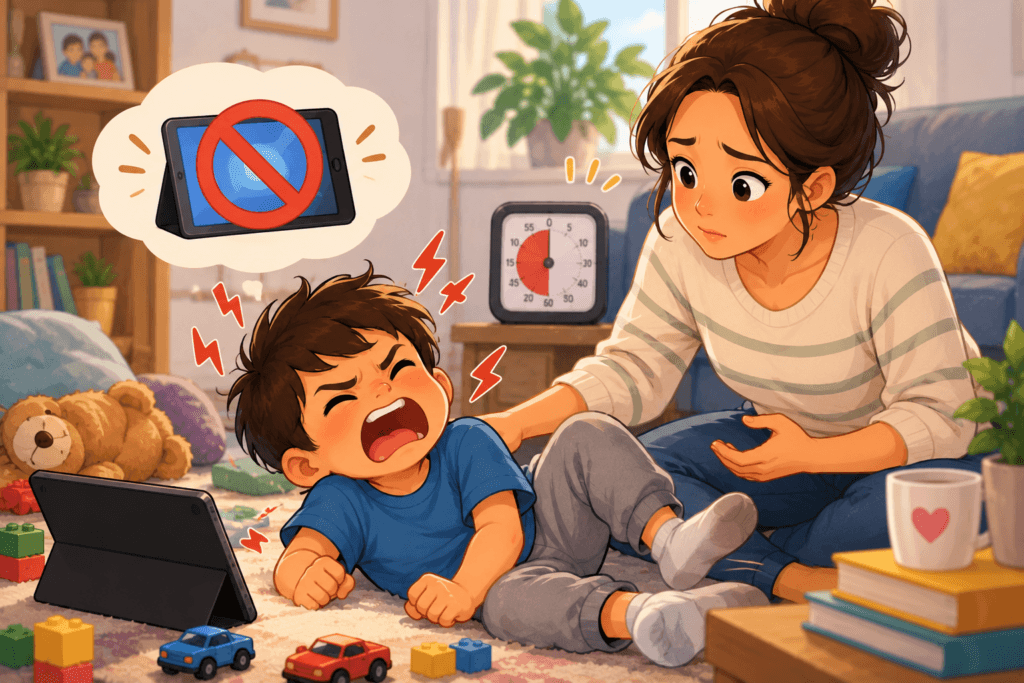
Nadia set the timer at four o'clock, which she considered a reasonable and even generous thing to do. At half past four the timer went and her five-year-old asked for five more minutes, and because the request was polite and she was answering an email, she said yes. At quarter to five she said the same thing again, less warmly. At ten past five she took the tablet, and the noise that followed was, by some distance, the loudest thing that had happened in her day, including a difficult call with a client.
She spent the evening feeling like she had handled it badly. What she had actually run into is a problem almost every parent has to deal with, and very few are warned about. The battle is rarely about how much screen time the child got. It is about the moment you ask them to stop, which means the question worth asking is not how much screen time to allow, but what is actually driving a child's meltdown after screen time ends.
Think about what you’re actually asking. A child is deep inside something engineered by professionals to be absorbing, with no natural pauses and no obvious ending, and you are asking them to leave it, immediately, on your schedule, and switch to dinner or homework or chores. Adults find that hard. We do a milder version of it every time we say we will close one more tab and then do not.
The screen also tends to arrive at the exact moment when nobody has the capacity for a negotiation. It buys you the last twenty minutes of a call. It covers the gap between school and dinner when you are working from home, and the meeting has overrun. That is not a failure of discipline; it is a real solution to a real constraint. What makes it costly is that the same twenty minutes of peace has a bill attached, and the bill is due exactly when you have the least left to pay it with.
The scale of the reaction confuses parents more than anything else. A child who accepts being told to put on shoes will come apart entirely over a tablet, and it looks like defiance. Usually something more ordinary is going on:
A meltdown at the end of screen time is not proof of anything about your parenting. It is a child with an underdeveloped ability to switch tasks. That does not mean you give in. It means you stop reading the reaction as a verdict.
Parents tend to assume everyone else has this sorted, which makes the whole thing lonelier than it needs to be. A 2024 study of 901 caregivers here, led by Phaik Ling Quah at KK Women's and Children's Hospital, found that only 9.4 per cent of preschool children aged three to six met Singapore's screen time guideline. More than nine in ten families are in the same position you are.
The guidance itself is worth knowing, if only so you can decide what you are aiming at. The Ministry of Health's January 2025 guidance recommends:
- under an hour a day outside school for children aged eighteen months to six,
- under two hours for seven-to twelve-year-olds unless it relates to schoolwork, and
- no screens during meals or in the hour before bed.
It also says something that most coverage skipped over: "Parents should role-model positive screen-use behaviours and habits for their children." That line is uncomfortable, and it is also the most useful part of the document, because children calibrate what is normal from what they watch you do with your phone at the dinner table.
None of these end the battle. They change the shape of it.
The evening handover is the one that costs you twice. A screen too close to bedtime leaves a child wired at exactly the point you need them winding down, and the resistance that follows is easy to mistake for a bedtime problem when it started an hour earlier. If your evenings have quietly become a fight, look at what happened at six rather than at eight.
It is also the point where parental guilt does the most damage. Parents who have been at work all day often feel that they should not also be the one enforcing limits in the little time they have together, and so the screen stays on, and the settling at bedtime becomes harder every night. Holding a boundary in a short evening is not spending your connection time badly. It is the least glamorous form of connection there is.
Nadia did not solve this. What she changed was smaller: she started saying how long before she handed the tablet over, added a two-minute warning, and stopped answering the request for more while she was distracted, because distracted was when she always said yes. Some days it goes fine. Some days it does not, and she takes the device and lets the noise happen. The goal was never a child who hands the screen back happily. It was a household where the ending is predictable enough that everyone can see it coming.
How much screen time is recommended for children in Singapore?
The Ministry of Health's January 2025 guidance recommends no screens for children under eighteen months apart from video calls, under an hour a day outside school for eighteen months to six years, and under two hours for seven to twelve-year-olds unless it is schoolwork.
Should I take screens away completely if the meltdowns keep happening?
Removing screens entirely tends to address the symptom rather than the pattern, and in most households it is not sustainable for long. Making the ending predictable does more. If the reactions are escalating over months rather than settling, that is worth raising with your child's doctor or school rather than solving with a stricter rule.
Does giving five more minutes make things worse?
Granting extensions during a session teaches that the ending is open to negotiation, which tends to produce more requests rather than fewer. Deciding the limit before handing the device over, and saying it out loud, avoids putting yourself in that position.
Should I feel guilty about using screens to get work done?
It is a practical solution to a genuine constraint, and most households here use it. The more useful question is not whether you used a screen, but whether the ending was predictable, because that is the part that determines how the next hour goes.
Do screens really affect bedtime?
The MOH guidance advises no screen use in the hour before bed. Where evenings have become a struggle, it is worth checking what happened earlier in the evening rather than treating it purely as a bedtime issue.
Sources