
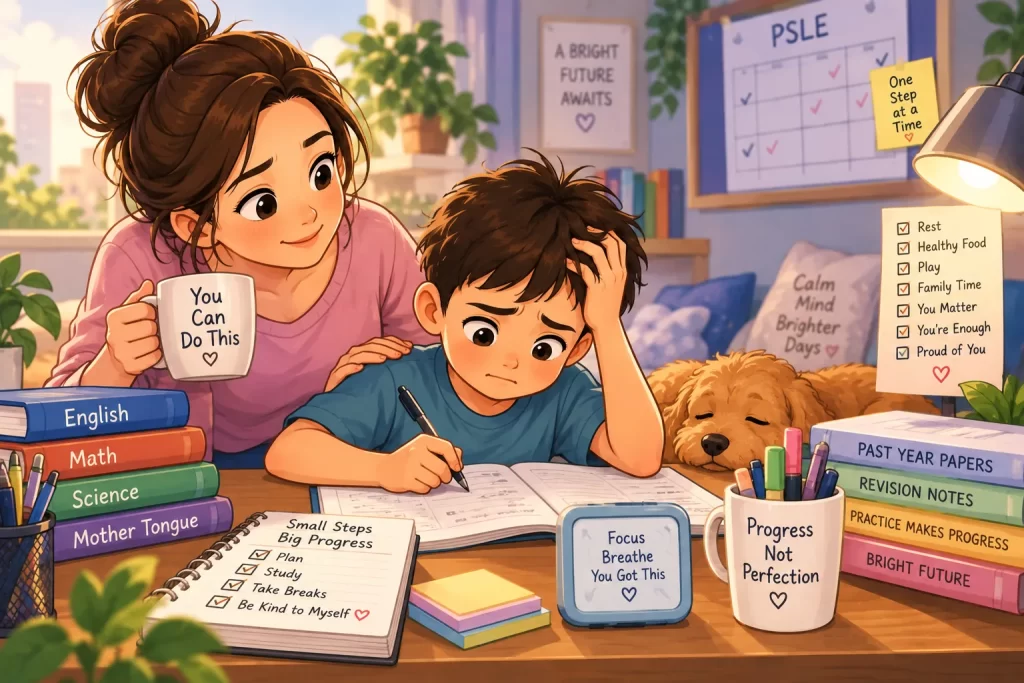
Adeline worked it out on a Tuesday night in August, standing in her kitchen at half past ten with a stack of past-years’ PSLE papers she had just sorted by topic. Her phone buzzed with a reminder she had set weeks earlier: book badminton. She could not remember setting it, or the last time she had played. When she looked at the month ahead, there was not a single evening she could fit it in. So she turned the reminder off instead of rescheduling it.
It was a small decision, but it told her something. Somewhere along the way, surviving PSLE had come to mean putting her own life on hold.
If your child is sitting for the PSLE 2026, the written papers run from 24 to 30 September, which puts you somewhere in the final stretch right now. Your child has a syllabus, a timetable, and a clear finish line. You have something less defined and much harder to put down: the tracking, the ferrying, the mood reading, the nightly negotiation about screens and sleep and whether tonight is a night to push or a night to let it go. Nobody handed you that job description, and nobody is going to tell you when it ends.
It starts with logistics, and logistics feel manageable. You move a meeting so pickup works. You take the Wednesday call working from home so you are there when he gets back from the tuition centre. You stop saying yes to things on weeknights because the evenings now belong to revision, and that seems reasonable, because it is only for a season.
Then the season stretches from March to September, and you notice you have quietly stopped being a person who does anything at all. Somewhere along the way, surviving PSLE has become less about getting your child through the exam and more about organising your entire life around it.
The scale of that coordination is not imaginary, and the money is the visible half of it. Singapore families spent $1.8 billion on private tuition in 2023, according to the Department of Statistics' Household Expenditure Survey, and behind every one of those payments somebody is doing the researching, the booking, the ferrying and the remembering. That is invisible work, and it does not appear on any calendar because it lives in one person's head. The mental load of a PSLE year is not the classes. It is being the only one who knows what happens next.
Kristina Göransson of Lund University spent several years interviewing Singapore parents about how they experience their children's educational transitions, speaking with twenty-nine parents in depth. What she found was not a story about tiger moms and dads pushing their kids to the brink. It was a story about anxiety management, and about a fear of getting it wrong in either direction. One mother in her study put the bind exactly: "I don't know, have I been letting him play too much? Have I not been pushing him hard enough? Mommy guilt."
Another line from the same research is the one worth sitting with. A mother, describing the year afterwards, said simply: "I felt like I just wanted my life back after the PSLE." She was not complaining about her child. She was naming something that happens quietly to a lot of parents in this window, which is that the self gets shelved with the best of intentions and is surprisingly hard to retrieve.
Göransson also captured the social pressure sitting on top of all this. As one mother observed, "the popular thing to do is to be chill." You are meant to be relaxed about it, publicly, while privately believing that this exam shapes what comes next for your child. Performing calm while feeling anything but is its own kind of tiring, and it is a large part of why this season costs parents so much.
Most parents say that they are not panicking and feel like they have it all under control. So they do not think of themselves as being stressed, much less burned out. They feel busy, competent, and slightly grim, which is a normal Tuesday in Singapore.
What they miss, however, are the signs of burnout that tend to be quieter. If you feel any of these signs, it’s best to talk to a professional.
Your child is likely feeling their own version of this.
A 2025 report by Every Child SG, drawn from interviews with fifteen mental health practitioners, estimated that between half and seventy per cent of their local school clients rate academic pressure as a significant source of stress. You are not imagining the weather in your house. You are living in it and managing it at the same time.
The standard advice is to be more relaxed, and it does not work because nobody has ever become calmer by being told to be calmer. What tends to work better is smaller and more concrete: protect a few specific things rather than trying to change how you feel. Your child does not need you to stop caring. They need to see that a whole adult is still in the house, because that is what tells them the exam is important rather than total.
Pick three and defend them.
You may also notice your child is moodier, snappier or flatter than usual as the papers get closer, and it is easy to read that as a verdict on how you have handled the year. It is not proof of anything about your parenting. It is a tired eleven-year-old carrying something large. The same goes for the guilt you feel when you finally book the badminton court. Many parents find it far easier to authorise rest for a child than to spend anything on themselves, and that instinct is worth noticing rather than obeying.
Adeline did book the badminton for a Thursday in the second week of September, and she felt faintly guilty about it for most of the drive there. The house did not fall apart. Her son did not lose a grade. What she got back was smaller and more useful than a break: a couple of hours in which nobody needed anything from her, and a reminder that the person she had shelved in March was still available.
The season will still be demanding, and there will still be evenings that go badly. Losing yourself is not the price of taking this seriously, and finding out that it is not the price is easier while the season is still running than after it has finished.
Focus on protecting the conditions rather than managing the content. Sleep, food, a predictable end to the evening and one daily conversation that is not about school do more for a child's performance than another hour of drilling. Taking over the work tends to signal that you do not think they can carry it.
It reads as selfish and functions as the opposite. Children take their emotional cues from the adults around them, and a parent who has some life outside the exam is easier to be around than one whose entire month depends on the outcome.
It is very common. Children often have a narrower view of the exam than parents do, while parents are holding the logistics, the outcome, and the long-term implications at once. That combination keeps running after the child has gone to bed.
Because it asks you to change a feeling rather than a behaviour. Research on Singapore parents found that being visibly relaxed is itself a social expectation, which means many parents end up performing calm on top of the anxiety rather than instead of it. Changing one or two specific habits is more achievable than changing your temperament.
Less than you think. Stop introducing new material, hold the sleep routine, and keep the house boring and predictable. The final week is about steadiness, not gains, and your steadiness is the part your child will actually notice.
Sources