
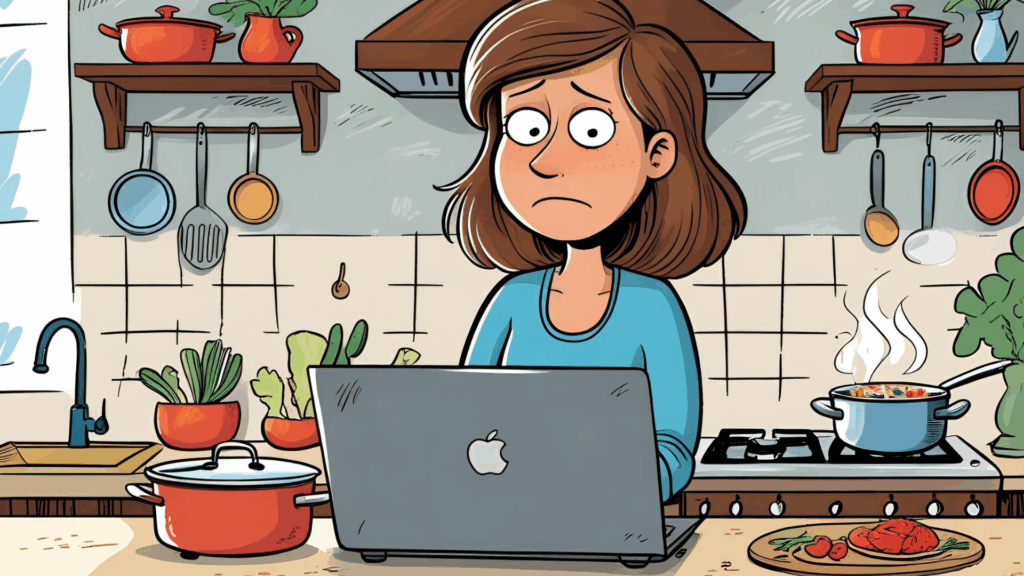
Working mom burnout rarely arrives with a dramatic announcement. It's not like one morning you'll wake up and think, “This is it. I am officially burned out.”
Instead, it tends to creep in through ordinary days that somehow feel harder than they should.
Let me paint a picture.
Last Tuesday, I was standing at the kitchen counter eating cold rice, my laptop open next to the sink, my 5-year-old daughter tugging at my shirt, and a message blinking on my phone. I hadn't even showered. The laundry pile behind me had basically become part of the furniture. And I still had a long list of tasks waiting to be done before the day ended.
I remember thinking, "I'm so tired. But I can't stop now."
Sound familiar?
For many working moms, exhaustion can become so normal that they stop questioning it. The early mornings, meetings, school forms, meals, messages, errands, bedtime routines, and endless small decisions become one continuous list of things that need to be handled.
You keep going because there is always something else that needs you.
But there is a difference between having a difficult week and being caught in a longer cycle of exhaustion and stress.
That distinction matters. Working mom burnout is not simply being tired after a busy week. Burnout is associated with prolonged exposure to chronic stress, particularly when the demands placed on you continue without enough opportunity to recover. Current workplace research continues to show the scale of the problem. McKinsey’s 2025 Women in the Workplace research found that 42% of women surveyed reported frequently feeling burned out at work in the previous few months, rising to 60% among senior-level women.
Research from the McKinsey Health Institute has also found that women caring for children report greater exhaustion than men do.
These numbers do not mean every exhausted working mother is clinically burned out, but they do show why the experience deserves more than another reminder to “take better care of yourself.”
The word "burnout" gets used for almost any kind of exhaustion. It's worth being precise.
The World Health Organization describes burnout as an occupational phenomenon resulting from chronic workplace stress that has not been successfully managed. It includes exhaustion, increased mental distance or negativity toward one's job, and reduced professional efficacy.
It is different from simply having a stressful day or feeling tired after a busy week.
For working moms, the experience can become harder to recognise because work is only one part of the picture.
You may finish your workday and immediately move into another set of responsibilities. There is no clear point where the demands stop.
You are still answering questions, making decisions, organising schedules, remembering appointments, preparing meals, and responding to everyone else's needs.
So the question isn't simply, "Am I tired?"
A better question is:
Has exhaustion become the way I experience most of my days?
You may sleep, take a day off, or spend an evening doing very little and still feel as though you've not properly recovered.
This happens because your burnout isn't going to be fixed with one more night's sleep.
The problem is that your mind never really switches off.
You finally sit down with a cup of tea, but you're thinking about tomorrow's meeting. You put your feet up after dinner, but your mind starts running through the school forms you still need to fill in. You are lying in bed, relaxing, while mentally running through everything that needs to happen the next morning.
Your 'rest' is physical, not mental. And that's why you feel exhausted even after 'resting'.
Your body has stopped moving, but your brain is still working.
A missing school uniform.
Realising you're out of milk just as you're making dinner.
One more request after a long day.
Your child asking the same question for the fifth time.
On their own, these things are manageable. But when you're already stretched thin, one more demand can feel like the thing that pushes you over the edge.
You may become irritated more quickly than you normally would.
You may hear yourself saying, "I can't deal with this right now," even when the situation itself isn't particularly serious.
That doesn't automatically mean you're an impatient parent. It may simply be a sign that you're running on empty and have very little left to give.
You are sitting with your child, but thinking about work.
You are in a meeting, but worrying about what needs to happen after school.
You are having dinner, but mentally organising tomorrow.
This kind of constant switching can make it difficult to feel fully present anywhere.
And that can create another layer of guilt.
You may think:
"I'm spending time with my child, so why don't I feel like I'm actually here?"
You skip lunch because there is one more email.
You drink coffee instead of sitting down for a proper meal.
You postpone a shower because the children need something.
You tell yourself you'll exercise, read, rest, or meet a friend when everything else is finished.
When your own needs always come last, you may start treating rest and recovery as something you have to earn rather than something you need.
This one can be particularly difficult to admit.
You love your family.
You care about your work.
You may even be grateful for both.
And yet you can still feel resentful when someone asks you for one more thing.
When every part of your day involves responding to somebody else's needs, having no time that belongs to you can eventually become exhausting in itself.
Burnout and prolonged stress can change how you experience ordinary parts of your life.
The activity that normally helps you unwind starts to feel like another task.
Meeting a friend feels like something you need to organise rather than something you look forward to.
Playing with your child feels like another responsibility instead of something you can enjoy.
Even weekends can become recovery periods spent catching up on everything that didn't get done during the week.
When your life becomes almost entirely about getting through the next task, there is very little room left for enjoyment.
This is often one of the hardest signs to explain.
You are still doing everything.
The children are getting where they need to go.
Your work is getting done.
The house is functioning.
From the outside, nothing looks particularly wrong.
But internally, you feel different.
You have less patience. Less curiosity. Less energy. Less enthusiasm.
You may even wonder where the version of yourself who used to enjoy things, make plans, or feel excited about the future has gone.
A working mom usually manages her job while also carrying a large amount of the invisible load that keeps the family life moving.
There are the obvious tasks:
* School drop-offs and pick-ups
* Meals and groceries
* Household chores
* Children's activities
* Work meetings and deadlines
Then there's the mental load behind them:
* Remembering what needs to be bought
* Knowing when school forms are due
* Planning the week's schedule
* Anticipating what the children will need
* Remembering birthdays and appointments
* Thinking about what needs to happen next
The mental work does not stop simply because you're technically "off work."
And when you are accustomed to being the person who notices what needs doing, you can start automatically absorbing more.
Someone asks, "What should we do?"
You decide.
Someone forgets something.
You remember it.
Something needs organising.
You organise it.
Over time, this can create a cycle:
More demands → less recovery → more exhaustion → lower capacity → more irritability → guilt → trying harder.
Trying harder may help you get through a particularly difficult day. But it's not a sustainable solution to a long-term overload problem.
Ignoring burnout doesn’t make it go away; it makes it deeper.
Here’s why recognizing working mom burnout signs matters:
Chronic stress can lead to fatigue, anxiety, and even long-term health issues.
Burnout can make you more irritable, less patient, and emotionally drained—both at work and at home.
As a leader, your clarity, decision-making, and energy are essential. Burnout can cloud all of these.
Even when you try to hide it, burnout can affect how you connect with your children and loved ones.
You don’t have to live in survival mode. Recognizing the signs is the first step toward change.
When life feels chaotic, the natural response is often to become more efficient.
Make a better schedule.
Wake up earlier.
Plan meals.
Use a new app.
Create another checklist.
Organise the family calendar.
Some of these things can genuinely help.
But these cannot make your burnout go away.
If every spare minute is already allocated, becoming more efficient may only create space for another task.
This is an important distinction.
Sometimes the question is not:
"How can I fit everything in?"
It is:
"Does all of this actually need to fit?"
That shift can change the conversation from productivity to priorities.
Balancing motherhood and leadership doesn’t require perfection, it requires intention.
Here are realistic ways to prevent and manage burnout:
Not everything on your list is urgent. Focus on your top priorities each day and let go of unnecessary pressure.
Create limits around your time and energy. Whether it’s ending work at a certain hour or protecting family time, boundaries help you recharge.
You don’t have to carry everything alone. Delegate tasks at work and involve your family at home.
Rest is not a reward, it’s a requirement. Even small moments of pause can make a difference.
You will have imperfect days, and that’s okay. Speak to yourself with the same kindness you offer others.
Ask: “How am I really feeling?” Awareness helps you catch burnout before it worsens.
The first step does not have to be a complete life overhaul.
In fact, adding a complicated self-care routine to an already overloaded schedule can become another source of pressure.
Start smaller.
This is where the 3 A's can help:
Start by saying what is actually happening.
"This is hard, and I'm tired."
Not:
"I should be able to handle this."
Name what is draining you.
Is it the constant decision-making?
The workload?
The lack of uninterrupted time?
The feeling that everyone depends on you?
The inability to switch off after work?
You cannot change a problem you're still pretending is manageable.
Once you know what is draining you, look at what can change.
This is where your boundaries become practical rather than theoretical.
Maybe you need to stop answering work messages after a certain time.
Maybe someone else can take responsibility for a recurring household task.
Maybe your partner needs to take ownership of something rather than simply helping when asked.
The goal is not to make your life perfectly balanced.
The goal is to stop treating your own capacity as unlimited.
This may be the hardest one.
You can forget the school memo and still be a good parent.
You can need space and still be present.
You can have an untidy house and a healthy family.
You can say no.
You can ask for help.
Being responsible doesn't mean being available for everything, all the time.
Sometimes "good enough" is not a failure to meet the standard.
It is recognising that the standard itself needs to be realistic.
It is tempting to treat burnout as an individual problem. And the solutions that you see online are pretty generic:
Those things can all have a place, but they don't automatically address the demands that create the exhaustion in the first place.
If your workload is consistently excessive, your boundaries are unclear, you have little control over your time, or you're carrying too much responsibility at home, adding another task to your personal wellness routine may not solve the underlying problem.
That's why preventing burnout often requires looking beyond the individual.
Ask:
These questions are more uncomfortable than simply downloading another productivity app.
They can also be more useful.
You do not have to run yourself into the ground to prove that you are committed.
Your children do not need a perfect mother.
Your workplace does not need you to be available every minute.
And you do not need to earn the right to rest by finishing every task on your list.
Start with one thing.
Acknowledge what is exhausting you.
Assert one need.
Accept that enough can be enough.
Because being a working mother should not require you to disappear underneath all the things you do for everyone else.
If you recognise yourself in this article and want support working through the patterns behind your exhaustion, Bricks and Blocks Coaching can help you look at what is taking up your time, energy, and emotional capacity, and work towards changes that are realistic for your life.
We specialize in helping individuals find the right strategies and offer tailored support to help parents navigate their unique challenges and find a path that works for them.
Reach out to us to learn more about how we can assist you in your parenting journey.